Optimise for the life, not the money
For the last 30 days I have been reading the Saturday essay from Justin Welsh.
I went in with one question. How do you make the big decisions about the opportunities that come your way?
You and I both have the list. Should I sell agents solo? Should I write a paid newsletter? How about a free Substack that feeds a paid one? Should I open an AI automation agency? Should I sell lead gen? Should I do a traditional brick and mortar business, like selling clothes? Or maybe an e-commerce store?
All I want is to run a coffee shop in the end, so maybe I should do that now?
And most of the time, you and I answer that question by looking at the money at the end. How many dollars is this going to make?
Where the number comes from
It comes from the people around us, and from the expectations they set.
A lot of the time those people don’t even exist in our physical life. They are people on Substack, X, LinkedIn, Instagram or Threads. Bragging right now and triggering envy in us.
But interestingly, they’re not the cause of our envy. Our reaction is. They are not the ones making us jealous. We are the ones becoming envious.
So the hard decisions end up being led by a financial goal mixed with envy, rather than by a realistic motivation.
That is a destructive way to live.
I have seen this pattern in myself, and in enough people to call myself a ‘Professional Self Sabotage Analyst’. My conclusion?
We get trapped in analysis paralysis because we are trying to scale before we have even started.
We try so hard to get every detail in place, the landing page, the checkout flow, the “lesson #1”, that everything feels like it’s moving. But nothing tangible is standing. And it happens because no one gave us the framework we needed.
The lifestyle comes first
What I have realised is that before I can scale, I need to make a decision based on the kind of lifestyle I am opting for.
- Do I want to work like crazy and make crazy money?
- Do I want to complicate my life and sell a lot of my time?
- Does everything become a bespoke, high-ticket service, or is everything automated and happening on its own?
- Do I sell a digital product, group coaching, or focus on 1:1 consults?
The angle that makes these decisions workable is to optimise for the life. Because whatever you choose is going to be the reality of your days.
So let’s go through them, one at a time. Eleven ways to make a living, and the lived experience of those days.
If you sell a paid newsletter, the deadline never ends
A paid newsletter looks like a digital product, and it isn’t one. A product is finished. A subscription is a promise about next week, and then the week after that, with no end date.
The day is close to the digital products day. You are still in the room, writing. The difference is what you are writing. It is not the copy that sells the thing. It is the thing.
And it has to be good enough, every single week, that somebody decides again to keep paying for it. When a week or two slip, people cancel, and you feel it in the number straight away.
| Time | Activity |
|---|---|
| 9:00 to 12:00 | This week’s issue |
| 12:00 to 1:00 | Research and notes for next week’s |
| 2:00 to 3:30 | More of this week’s issue, or editing it |
| 3:30 to 4:30 | Posts, to grow the free list that feeds the paid one |
| 4:30 to 5:00 | Who joined, who cancelled |
| Evening | Yours, unless it is the night before it goes out |
If you write in bursts, it will hurt. It won’t work because it demands consistency. But if you love the weekly rep, and if you can make it like hitting the gym at 8.30 or 6.30 on the dot, it’s the simplest life of the eleven.
Questions to ask yourself
- Are you okay with a deadline every week, for years?
- And are you skilful enough to not meaninglessly click around browser tabs, WhatsApp, Instagram or any other distraction that pops up when you write?
If you open a coffee shop, you are there when the doors open
I am giving this one its own section, because it is the daydream almost everybody has at some point. A small, warm place. Regulars. Good coffee.
Now model the day.
The doors open early, because that is when people want coffee. So you are there before that. You are on your feet. You are there on weekends, because weekends are the busy days. When somebody on the team doesn’t turn up, get ready to be the backup barista.
| Time | Activity |
|---|---|
| 6:00 to 7:00 | Open up, machines on, deliveries in |
| 7:00 to 11:00 | The morning rush, on your feet |
| 11:00 to 1:00 | Lunch service |
| 1:00 to 3:00 | Orders to suppliers, the rota, something that needs fixing |
| 3:00 to 6:00 | Afternoon service |
| 6:00 to 7:00 | Clean down, cash up, lock up |
The daydream is sitting and watching people talk. The reality is dialling grinders, finding someone to fix the boiler in your La Marzocco and serving sweet, milky Spanish lattes even if you write “PANAMA GEISHA” in bold, font size 500 at the top of the menu.
Are you okay with a writer or vibe coder coming in at 8am, ordering one coffee and practically finding ways to never leave?
If you do the work for them, you have as many bosses as you have clients
This is the agency. Somebody has a problem, you agree a price, and you hand back the finished thing. Design, ads, writing, lead gen, an AI automation.
It is the fastest of the eleven to get paid for, because the client has to learn nothing and change nothing. You and I can start one this week with no audience at all.
But look at who decides your day. Every client is a small employment relationship. Each one sends revisions. Each one has a deadline that is more urgent than the other one’s deadline. And each one asks for the thing that was never in the scope.
| Time | Activity |
|---|---|
| 9:00 to 12:00 | Client A’s work, due today |
| 12:00 to 1:00 | Revisions from client B that arrived overnight |
| 2:00 to 3:30 | Client C’s work |
| 3:30 to 4:30 | Outreach, because one of the three will leave eventually |
| 4:30 to 5:30 | Invoices, status updates, a scope conversation |
| Evening | Checking messages, in case somebody is waiting on you |
You are doing the same kind of work every day, for other people, on their clock.
Are you okay being told what to do, by several people at once?
If you sell your time by the hour, the day is the same at $50/hour or $500/hour
Your calendar fills with appointments, and your entire day is spent talking.
The more talking you do, the more thinking you do. The more thinking you do, the more heating up happens. And the more heating up happens, the more overthinking happens.
It doesn’t matter whether you charge $50 or $500 an hour. The day looks the same.
| Time | Activity |
|---|---|
| 9:00 to 9:30 | Prep for the first call |
| 9:30 to 10:30 | Call |
| 10:30 to 11:00 | Review meeting notes & email while it is fresh, prep for the next |
| 11:00 to 12:00 | Call |
| 2:00 to 4:00 | Two more calls |
| 4:00 to 5:00 | Writing the content that fills next month’s calendar |
| Evening | Still replaying the conversations |
So it begs the question: will even a ridiculous amount of money let you optimise for the lifestyle that suits you best?
If you are someone who likes to talk a lot and enjoys the thinking that comes with it, great. If you are not, this is the point where you think twice.
If you teach a live cohort, you are on calls delivering it. And on calls selling it.
In a live cohort, you promise a result over a fixed number of weeks. A group of people go through it with you, with one-on-one time inside.
What people pay for is not the information you deliver. It is you, answering questions in real time, and putting them alongside people at exactly the same stage of the journey.
It carries the highest price of anything you can teach. And the reason is that you are in it, personally, the whole way through. And it’s also why selling a coaching product demands a sales call.
So there are two sets of calls. The calls where somebody decides whether to join, and the calls where the people who joined need you. Some of them won’t do the work, and will still expect the result. Part of the job is holding that gap, and their mood while they are in it.
| Time | Activity |
|---|---|
| 9:00 to 10:30 | Group coaching call |
| 10:30 to 12:00 | One-on-one calls with people who are stuck |
| 1:00 to 3:00 | Sales calls, some of which don’t show up |
| 3:00 to 4:00 | Content, to fill the sales calendar |
| 4:00 to 5:00 | Contracts, payment plans, tracking who is falling behind |
| Evening | A message from a student who is struggling |
It is the selling-your-time day with a sales day stacked on top.
Are you okay to lead a group and perform for it?
It’s not humiliating, but it demands that you’re skilled at not judging yourself when you’re leading people. You have to dance without the performance anxiety.
If you sell digital products, you spend the day in a room with the copy and with the fulfilment
People go through a funnel. So your time, instead of being spent on people, is spent on copy and the experience of the product.
It is spent choosing the right words to trigger the right psychological response. What goes into that copy matters so much that you put your heart and soul into it. You spend the entire day in a room, writing and writing and writing, or getting AI to write and then editing it. Because let’s be honest, AI can join words but editing, giving it substance and meaning is always your job.
And then it’s spent on what happens after they make a purchase. What’s step 1? A button in a UI? An AI Agent? A course video?
| Time | Activity |
|---|---|
| 9:00 to 12:00 | Writing the sales page, or the emails that lead to it |
| 12:00 to 1:00 | Posts, so that new people find the first email |
| 2:00 to 4:00 | Editing what you or the AI wrote this morning |
| 4:00 to 4:30 | Figuring out the product user experience |
| 4:30 to 5:00 | Support inbox: a login problem, a refund request |
| Evening | Yours. Nobody is waiting on you |
Nobody calls. Nobody sends revisions. It is you, the page, the product and the analytics that tell you whether the words sold and whether people actually used your product.
It’s the one that requires the most discipline, accountability and clarity WITHOUT relying on anyone to check up on you.
So are you okay being in a room where you are writing or producing all day, often solo?
If you run a community, people will leave, even the happy ones
Are you okay answering community questions?
A real community is not a course wrapped in Skool. It means intimacy. It means real-time action, one-on-one calls, group calls, live calls, all of it. They want answers to questions you’ve already answered. ALL THE FRIGGIN TIME!
| Time | Activity |
|---|---|
| 9:00 to 10:00 | Questions that came in overnight |
| 10:00 to 11:00 | Welcoming new members, getting them to their first post |
| 11:00 to 12:00 | Preparing this week’s workshop |
| 2:00 to 3:00 | Live group call |
| 3:00 to 4:00 | More questions, and a disagreement between two members |
| 4:00 to 5:00 | Next month’s events, because a quiet community dies in public |
| Evening | One more look, in case something needs you |
And despite all the effort you put in, people are still going to leave. Some of them will be happy and leave anyway, because they got what they came for. The Stripe payment and churn unsubscribe notifications can go head to head, even when you’ve cracked it.
Are you okay with that? It feels like a micro breakup and while very very very small, it happens enough times to prick. Tingggggggg.
If you sell software, you fix what broke and you build what your users want
Software is the one where you are not in it at all. The customer gets the same thing whether you are awake, asleep, or on a beach. That is the dream, and it is a real one.
It is also the slowest of the eleven to pay you. The product has to exist, and work, and matter, before anybody can subscribe. That is months of building with nothing coming in.
And once it is live, it is live all the time. The day does not start with what you wanted to build. It starts with what broke.
| Time | Activity |
|---|---|
| 9:00 to 10:00 | Support: a bug, a failed payment, a confused new user |
| 10:00 to 1:00 | Fixing the bug, then building the feature users asked for |
| 2:00 to 3:30 | More building |
| 3:30 to 4:30 | Getting people to try it |
| 4:30 to 5:00 | Who signed up, who left without saying why |
| Any hour | Something is down |
Most of the features you are excited about, you will have to drop. The ones your users want will come first.
Are you okay building for months before the first dollar, and then maintaining it forever?
If you sell physical things, in a shop or online, the stock runs your day
This is the brick and mortar business, the clothes shop, and its online twin, the e-commerce store. I am putting them together because the same thing sits at the centre of both: stock.
You buy it before you sell it. So your money is sitting on a shelf, or in a box in a warehouse, and the day is organised around moving it. What is selling, what isn’t, what needs reordering, what arrived damaged, what came back.
With a shop, you add the hours. The door opens at a time, and somebody has to be standing behind it. With a store online, you swap the door for ads, product photos, shipping and returns.
| Time | Activity |
|---|---|
| 9:00 to 10:00 | Yesterday’s orders: pack, ship, or restock the floor |
| 10:00 to 1:00 | Shop open and serving, or product pages and ads |
| 2:00 to 3:00 | Suppliers: reorders, late deliveries, prices |
| 3:00 to 4:00 | Returns and complaints |
| 4:00 to 5:00 | Counting what is left, and what it cost you |
| Evening | The shop is still open, or the orders are still coming in |
None of this is in your head. It is boxes, sizes, couriers and rent.
Are you okay to constantly balance inventory, suppliers and sales?
If you take a job, somebody else has already designed your day
I left this one for the end, because it is the one you and I know best. Most of us are in it, or were.
A job is the only row where the day arrives finished. The hours, the place, the people, the meetings. You don’t model it. You are handed it.
And there is a lot to like in that. The money lands on the same date every month. Nobody churns. You don’t have to find the next customer, write the copy, or chase the invoice. It feels safe and predictable until it isn’t.
| Time | Activity |
|---|---|
| 7:30 to 9:00 | Commute |
| 9:00 to 10:00 | Stand-up, email, what changed overnight |
| 10:00 to 12:30 | The work you were assigned |
| 1:30 to 3:00 | Meetings |
| 3:00 to 5:30 | The work, or whatever became urgent since lunch |
| 5:30 to 7:00 | Commute |
| Evening | Yours, with what is left of you |
The trade is simple. You get certainty, and you give up the design of the day.
Are you okay with a life that somebody else fills in?
If the job is remote, the place changes. The priorities don’t.
This is the one people think is the escape. No commute. Your own kitchen. Lunch with your family. A walk at 3pm if nobody is looking.
And all of that is real. A remote job gives you back the where, and a good part of the when.
| Time | Activity |
|---|---|
| 8:45 to 9:00 | Laptop open at the kitchen table |
| 9:00 to 10:00 | Stand-up on video, messages, what changed overnight |
| 10:00 to 12:30 | The work you were assigned |
| 12:30 to 1:30 | Lunch at home |
| 1:30 to 3:00 | Meetings, on video |
| 3:00 to 5:30 | The work, with one eye on the green dot next to your name |
| Evening | No commute. The laptop is still on the table |
Now put that calendar next to the one above it. The commute has gone. 10:00 to 12:30 is the same.
Because what doesn’t change is what you get to work on. Even if it is a job of your liking, in a field you chose, with people you respect. You are never the one setting the priorities, and you are never the one setting the scope of work.
Somebody else decides what matters this quarter. You decide where to sit while you do it.
Are you okay with choosing where to work but not what to work on?
Your life as a function of the path
Dickie Bush’s experience, from his guide to the eight ways to make money online, is that each can reach $10,000 a month, and every one can pass $100,000. So the money does not separate them.
Instead, the decision comes down to this:
Which life brings you problems that you can accept and handle, with a tolerance for when they prick you?
Dark Matter is all about the choice you didn’t make. It’s about exploring the ‘What Ifs’ by walking into different versions of your life.
Great show and the lesson is simple: there is no ‘problem free’ path.
But the model is there to help you not regret the path you didn’t take. Don’t go chasing lavender wings or put yourself in superposition so you can overthink your way into lives that could have been or should have been.
Here’s all of it in one place. Put the choice in, and the day comes out.
| What you sell | Your day is mostly | Hours (deliver / market / operate) | What you put up with | Think twice if |
|---|---|---|---|---|
| Done-for-you agency service | Doing the same work for clients, on their deadlines | 50 / 25 / 25 | As many bosses as you have clients, and scope creep | You don’t enjoy being told what to do |
| 1:1 coaching or consulting | Calls, with the prep before and the follow-up after | 60 / 30 / 10 | Lumpy months, and income that stops when you stop | You don’t enjoy thinking on your feet, live |
| Live cohort | Calls delivering it, and calls selling it | 33 / 33 / 33 | People who don’t do the work and still expect the result | Leading a group and performing for it drains you |
| Digital products | In a room, writing copy, emails and funnels | 20 / 70 / 10 | Repeating yourself, and always looking for the next buyer | You think the product is the hard part |
| Paid newsletter | Writing the next issue, every week | 70 / 20 / 10 | A deadline with no end date, and churn | You write in bursts |
| Paid community | Hosting: events, questions, moderation, onboarding | 50 / 20 / 30 | People leaving, even the happy ones | You would rather teach than host |
| Software | Fixing what broke, building what users asked for | 50 / 25 / 25 | Bugs, support, and months of building before the first dollar | You lose interest after the launch |
| Physical goods, shop or online | Moving stock: orders, suppliers, returns | Money sitting on a shelf | You want a business that fits in a laptop | |
| Coffee shop | On your feet, serving, from open to close | Early starts, weekends, covering for staff | You want to choose your own hours | |
| A job | The work you were assigned, between two commutes | A calendar somebody else fills in | You want to design your own day | |
| A remote job | The same assigned work, from your own lounge | Somebody else’s priorities and scope | You want to choose the work, not just the room |
Read each row the way you would read a job description. That is exactly what your day in the life is.
And notice where the columns disagree with the envy. The person bragging about a $50,000 month on LinkedIn is showing you the tip of the iceberg.
Maybe they’re a glacier melting with insecurities and validation is the only fuel that keeps them alive?
Because their choices have left them with such little life.
Justin Welsh tells a story about this in an essay on not scaling. He was in a room with twelve other online entrepreneurs. One was a solo consultant doing around $1.3 million a year. Another was solo at a little over $900,000. Both profitable. Both, in his words, stressed out of their minds.
Not because business was bad. Because one of them believed he should be at $5 million by now, and the other believed she needed to hire a team and double.
They spent their whole turn talking about what they should be doing, and none of it on what they were already doing well.
That is the same envy I opened this letter with. And you know the funny thing? Even after touching ~$1,000,000, both people were living the same life with the same problems.
Being rich didn’t make their life better because they didn’t optimise for the lifestyle. They optimised for a number. And life is a lived experience.
Know what the money costs
The part of Justin’s essay I keep going back to is a man who runs a small design agency.
He has been at about $1.5 million a year for eight years. The same number, every year.
From the outside, that looks like somebody who is stuck.
He works 4 days a week. He takes six weeks off a year. He is home with his kids every night.
And he did the modelling. He worked out what it would take to get to $3 million:
- three or four more people
- more overhead
- and most of his own week moving out of design and into meetings and managing.
After all of that, he would take home about $850,000 instead of $700,000.
So the net net offer on the table was $150,000 a year, in exchange for a different day. He looked at a day in the life, and said no.
The scaling plan had nothing to do with making his life better.
It was something he thought would impress other people. A bad motivation.
He didn’t leave money on the table. He figured out what the money costs.
That is the whole function, run by somebody who is already there. He put the choice in, looked at the day that came out, and decided to optimise for life and not a number.
Because again, life is a lived experience.
Build the life first, then fit the business in the gaps
Justin has a sentence for this that he calls a mantra:
I will build my life first, and I will fill in the gaps with a business that supports it.
You and I usually do it the other way round. We pick the business, the business fills the calendar, and whatever is left over is the life.
Turn it round, and the order of the questions changes.
Not “which of these eleven makes the most?” but “what do I want 9am on a Tuesday to look like?” Then you go down the table and see which rows can live inside that.
What my own day looks like
So here is mine. This is a real Monday, for a routine I will follow till December 2026 at minimum.
| Time | Activity |
|---|---|
| 5:30 to 6:15 | Meditate, coffee, no laptop |
| 6:15 to 8:30 | Broad work |
| 8:30 to 9:00 | Family |
| 9:00 to 10:00 | Group practice |
| 10:00 to 2:00 | Preschool run, lunch |
| 2:00 to 5:00 | Broad work |
| 5:00 to 5:45 | Client calls, if there are any |
| 6:00 to 7:00 | Group practice |
| 7:00 to 9:30 | Dinner, family, in bed by 9:30 |
Two blocks of broad work. Two blocks of practice. Family in the middle and at the end.
And one slot for calls, 45 minutes long, at the end of the working day.
Now hold that against the eleven days above. Most of them do not fit. The coffee shop certainly doesn’t. Selling my time by the hour would take the two broad work blocks and turn them into talking. All I have is 5 hours for creative expression and decisions.
Quick digression: Voucher Cloud studied 2,000 full-time office workers and found that out of their 8 ‘working hours’, people were actually productive for only 2 hours and 53 minutes.
So the 5-hour figure I’ve come to, split across two very distinct parts of the day, is calculated.
Calculated to happen before anyone is awake and after everyone is busy
And it’s also calculated to NOT allow a couple of things.
#1 No hyper focus, with my eyes dialled in and locked into the screen
Because writing is expansive and divergent. That’s exactly why I have a ~6 hour gap between my two broad work blocks. It prevents overthinking and the kind of focus that leads me to be so lost in the detail that I can’t see the bigger picture. So laser focused on a task that I end up solving a problem nobody would pay for or care about.
#2 No ‘I can only work in one place’
Schools aren’t a conduit for creativity. At least not the traditional ones. They’re environments for mapped out, structured curriculums. Everything has a defined start and a defined end. Everything has a fixed shape which defines the boundary of where your thinking can go. And more importantly, where it shouldn’t go.
It’s actually why I found creative writing so hard at school and at university. This is often the trap I’ve found myself in by virtue of my STEM background.
And so I didn’t want my past career and my education to dictate how I work. After 3 years of using a study where my laptop, the 2 screens and every little peripheral has a defined place, I find myself not wanting to work there any more.
It’s not impossible to write there. But it definitely feels like an enclosure.
Which is why my deeper work happens in a park walk or while wrestling with my son
My writing rhythm lets me speak into my phone during a walk or playtime as and when ideas happen. The writing just flows as speech, it gets written in real time and the only role AI can play is to ‘unwrap and format’ it.
Phew, about raising boys… let me tell you something. Raising them is a completely different equation. They will run into a wall 10 times, get hurt, cry and still do it again. There’s no taming their energy when they’re ‘three-nagers’ (yes, it’s a legit term I promise).
And the only choice you have (at least as a Dad) is to meet their playful energy where it’s at. All that energy has to be utilised because otherwise, there ain’t gonna be no hush little baby, don’t you cry and instead Mama’s gonna go rocking mad.
Now this could be a blocker for many.
‘Well if you’re playing with your son, then how are you writing at the same time?’
Actually, it’s easy because I just talk into my iPhone, use AI to unwrap & format and edit on an iPad Mini.
This is not the deep work you have read about
If you have read Cal Newport, some of this will have sounded wrong.
Cal is a computer science professor, and he wrote the book that gave you and me the phrase deep work.
His definition is work done in a state of distraction-free concentration, pushing your mind to its limit. His advice on how to get there is a ritual: decide where you will work, for how long, and shut everything else out.
By that definition, a three-year-old climbing on your back is the distraction. A park is the wrong place. And speaking your thoughts out loud while somebody asks you for a biscuit is not work at all.
I agree with more of his book than it looks like.
- The rhythm. He says the simplest way to get deep work done is the same blocks at the same time every day, so you never have to decide. That is my 6:15 and my 2:00.
- The cap. He says about four hours a day is the limit for most people. I am at five, split in two.
- The walk. He recommends taking one problem on a walk and thinking it through on your feet.
Where I part with him is what deep means.
For Cal, depth is how hard you are concentrating. It is the right measure for his work. A proof has one right answer, and you get there by narrowing.
My work does not narrow. A letter like this one, or the decision about what to build next, gets better when it is allowed to wander.
When I lock my eyes on the screen for three hours, I go deeper, but not broader. I end up working in the dark in the same place on something I don’t know if anyone is going to want when it’s finished.
So for me, meaningful work is no longer how hard I am concentrating. It’s how authentic, how real and how clear what I am saying is when I say it. And I say truer things when my body is in motion, instead of when I’m sitting and stuck in one place.
That brings me to one more difference. If deep work needs the desk, then the life gets built around the desk.
So I have stopped calling mine deep work. I call it broad work.
Broad work is the same protected time, at the same hours every day. What changes is what the time is for. Deep work narrows until one problem is solved. Broad work widens until I can see which problem is worth solving, and then says it plainly. It lets the thinking wander across my notes, other people’s letters, a walk, a conversation with a three-year-old, because that wandering is where the connections come from.
Moving the body makes being creative infinitely easier.
It also changes what I count as done.
Not “how many hours and how many tasks”, but “did I say something true, and did it reach the people it was for?”. And broad work can happen in a park or on the lounge floor.
The life comes first and the work fits in the gaps.
Which is why I’ve picked paths that help me find and work with people I like
No coffee shop. No stock. No calendar full of calls. No ecommerce. No job, remote or otherwise, because I want to choose what to work on, and who to work with. Not just where to work from.
And after several “bespoke” implementations, I’ve learnt how to pick people who can help themselves. I want to write for, and run ads to, self-starters. And I believe these are the people of 2030.
Speaking of, what are the people of 2030 like?
Well, they’re the ones who have always been told “doing it yourself is for people who would rather waste time than pay and get it over with”.
That’s interesting, because across all my clients, the ones who wanted to do it themselves turned a profit, and those who wanted to constantly delegate made bad investments. They paid agencies $2500+/month and never got a return on their investment. All because they would do anything but equip themselves.
The people of 2030 are already the opposite.
They are the one in five people using Claude Code and installing a Second Brain Operating System.
- Writers
- Operators
- A mum organising voice notes from a stroller walk
They are the people who stopped paying for another monthly subscription and asked AI ‘How can I do it myself?’.
The reality? A lot of the “procedural, step by step” information work is exactly what artificial intelligence is trained for. It’s exactly why several things are now commodities:
- Apps
- Blogs
- Websites
- AI Agents
- Social Media Posts
- Dashboards, Documents and Reports
A commodity is something you don’t need me or an agency to do. Because AI can do it for you.
You just need a system like mine, which is exactly what I used to write this newsletter. And you need to stop saying “I’m not technical.”
2030 is a world where you have a Second Brain Operating System via your terminal, just like this
I said this earlier and I will say it again: 88% of what you just read was spoken, not typed.
No Notion. No Wispr Flow. No Google Keep and not even Apple Notes.
I said it into my iPhone, in three recordings, while playing with my son. What came out the other end was one long paragraph with no full stops, typos and your standard grammatical errors. Sometimes I like to leave them there to make a few people hiss 🙂
As soon as I hit enter on the recording, what I said was written to a file and saved to my iCloud. And synced to my Mac instantly.
Then I handed it over to my Second Brain OS, by accessing my computer from the same iPhone.
- It read the three recordings and worked out which of my writing voices they matched.
- It unwrapped the speech into paragraphs and headings, and told me what guesses it had made.
- It searched my notes and the newsletters I subscribe to by meaning, not by keyword, and linked the argument back to the exact pieces: Justin Welsh’s essay on not scaling, and Dickie Bush’s guide. I did not go looking for either.
- It drafted the “day in the life of” calendars you saw up there, so that I had something to improve instead of something to format.
Then I came back and edited the entire piece, top to bottom. On an iPad Mini, in the lounge, without opening the laptop once.
That edit took 44 minutes. The voice notes came to 12 minutes in total. My average when I “sit down to write” on a laptop is 3 to 4 hours. All because the writing had already happened when I spoke into my phone. It just needed to be organised and edited.
And it isn’t just ~70% more efficient. It’s twice as effective because I can write without losing my train of thought. To add, I didn’t get distracted by organising or editing while speaking. It all naturally became sequential because of the constraints. No intimidation of a blank page or a blinking cursor. No keyboard pressure to organise or edit while I write (speak, actually).
None of that is one clever app. It is several plain parts, each doing one small job, connected to form the ‘knowledge’ layer of my (and soon to be yours) Second Brain Operating System. And it’s bloody easy to set up.
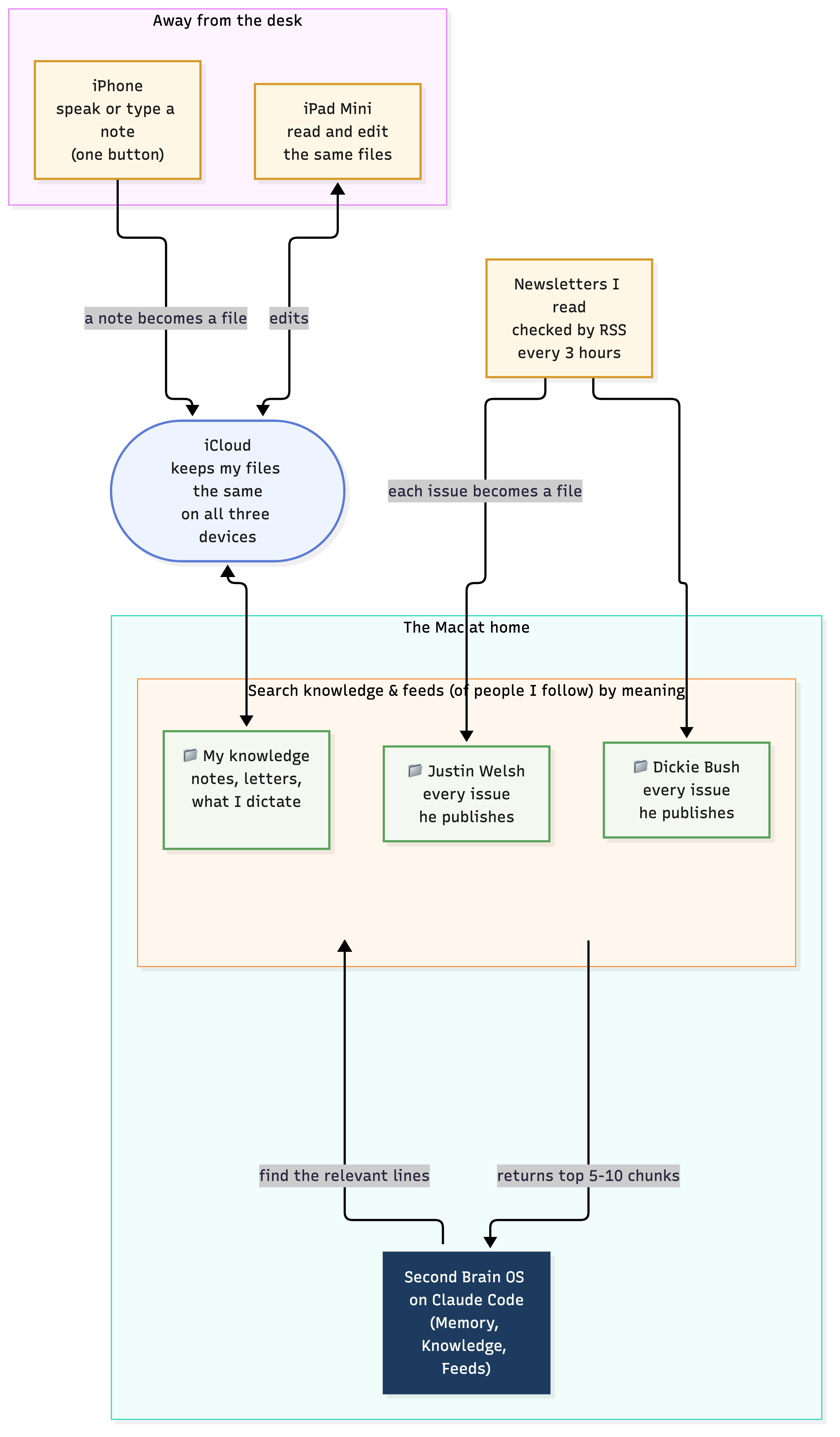
Markdown files, in separate folders. This is the ground everything else stands on. One folder holds my own knowledge: my notes, my past letters, and whatever I dictate. It sits on my Mac as plain text. No app owns it. It’s not on the cloud, it’s all on my machine.
A folder for each person I learn from. The newsletters I read do not get mixed into my own notes. Justin Welsh has a folder. Dickie Bush has a folder. So does every other writer I follow. That way I always know whether a line came from me or from them, and I can ask a question of one author, or of all of them at once.
Those folders fill themselves. Most newsletters publish a feed, called RSS, which is just a list of their latest issues that a program can read. Every three hours the Mac checks the feeds of the people I learn from, and each new issue becomes a file in that author’s folder. That is how Justin’s essay and Dickie’s guide were already there, searchable, and easy to link back to.
The iPhone is the way in. One button on my phone starts a recording. I speak, it turns the speech into text, and it saves that text as a new file in my knowledge folder. That is how I wrote 88% of this newsletter.
iCloud keeps my files the same everywhere. My knowledge folder sits in a place that iCloud syncs, so my Mac, my iPhone and my iPad are all looking at one copy. A note I speak in the park is on the Mac by the time I get home.
Claude Code as the operator. The terminal is the oldest and arguably most powerful way of using a computer. Claude Code runs inside it. It is, on the face of it, a coding assistant. The reason it matters here is not the coding part. It is that it can read the files in those folders before it answers, and write back into them.
The Second Brain OS transforms it into a thinking partner: it gives it my memory, my knowledge and my feeds to work from. It only ever writes from the Mac, which is why three devices can share the same files with 0 conflict.
Search by meaning sits between the centre and the folders. A new or changed file gets related by meaning to the others within seconds with Query Markdown (QMD). So the Second Brain OS never opens the folders and reads everything. It asks a question, like “who else has written about choosing the day over the number?”, and it finds the right page even when none of those words are on it, then hands back only the five to ten passages that matter. Not thousands of lines. Not whole files. It runs on my machine, and nothing in the folders gets uploaded to the cloud.
Memory is how it knows my preferences. Memory is a handful of short files it reads at the start of every session: no em-dashes, British spelling, which of my voices is which.
Hooks keep the time sheet. A hook is a tiny automation that fires at a set moment, like the light that comes on when you open the fridge. Mine fire when a session opens and as the work moves along. They record when Claude Code started, and the big deliverables it worked on. So I do not have to watch it work. I can stay on the editing, and afterwards look at a bird’s-eye view of what my Second Brain OS did, and when.
Git is how I see what changed. Git records the folder line by line. When a line changes, I see the old one in red and the new one in green. That is how I could tell, this afternoon, which edits to this letter were mine and which were the machine’s.
The iPad Mini is the way back in. Because my knowledge folder is synced, the draft is simply there on the iPad. I open the file and edit it like any other document. 300 grams, on the sofa.
Read the arrows in order and you have today.
- I spoke, and the phone made three files.
- iCloud carried them to the Mac.
- The search had already indexed them, next to every newsletter that arrived this month.
- The Second Brain OS read them, asked the search for what belonged with them, got back two pieces from two different authors’ folders, and wrote a draft into mine.
- iCloud carried the draft to the iPad.
- I edited it in the lounge.
The Mac never left the study. I was not in the study.
The room was never a requirement of the work. It was a requirement of the tools. For as long as writing meant a keyboard, and finding your old notes meant opening a laptop and clicking through folders, the writing and the room came together.
They don’t any more.
P.S. The agent that sets this up for you is called the Knowledge Work Coach. It is the first agent in the Second Brain Operating System. It takes you from a terminal you have never opened to your own notes searchable by meaning, with hooks, git, memory and phone capture in place, in about an hour. $36.
So what paths did I pick based on the lifestyle I want?
If the doing is a commodity, then I am going to race the world to the bottom. It’s an aggressive play where I’ve repackaged all the bespoke, custom work I did for thousands of dollars into DIY, low cost products. Because I am optimising for volume.
What is left is mostly one row, the one where I build a thing once and sell it many times. For me that thing is AI agents that do it for you: they take the procedural part off your hands, so the parts you focus on are creative or strategic.
I am selling ‘Done For You’ at the price of ‘Do It Yourself’.
Here is my whole plan, plainly.
Two funnels, one fed by content and one fed by ads. A funnel is the unglamorous name for the path a stranger walks from “never heard of you” to “bought something”, with each step solving the natural next problem.
- The organic funnel starts with the Knowledge Work Coach. Letters like this one feed it.
- The paid funnel starts with the AI Receptionist. Ads feed it.
A short paid call, at checkout. $63, added to an order by the people who want me on a call to get them moving. It is small on purpose. It is the only call most people will ever need.
A live coaching cohort. $289 a week for coaching + the agents handed to you, in four-week cohorts that start every month from 1st November 2026. Two live classes a week, on Saturday and Sunday, 100% of my attention. Immersive and paced at a balanced speed. After each call, an AI trained on my knowledge answers the questions people think of later, and helps them get unstuck between classes. I’ve designed this to group and equip the people of 2030 with the same AI Agents I use across my Second Brain Operating System. Each week has different AI Agents and by the end, you are capable of setting up a Second Brain OS for friends and clients. Cancel anytime you feel like you have what you want. What you get doesn’t get taken back.
Everything I teach is free. Search Google for the problem you have, plus my name, Umair Kamil, and you will find the course or the letter that solves it. Better still, you can chat with my AI directly on umairkamil.com and get to the answer faster. The self-paced courses also come attached to every agent I sell. Free on their own. Far more useful with the agent doing the work.
Bespoke work, with self-starters. When someone has made the effort, I am there to handhold and set up their Second Brain Operating System in a very customised manner. Though, I am very selective about this. And rightly so because I like to pick winners who scale to 2030 with an unfair advantage before everyone else.
Here are all the problems I solve.
| What you get | What it does for you | Price | Where it sits |
|---|---|---|---|
| Knowledge Work Coach | Sets up Claude Code the privacy-first way, makes your notes searchable by meaning, and lets you capture from your phone | $36 | Start of the organic funnel |
| Productivity Coach | Writes your day down, backs it up, and makes your Mac reachable from an iPad Mini | $198 | The next step after the Knowledge Work Coach |
| Clone Yourself Coach | Gives your agent a knowledge base of your own, so it answers the way you would and push it to your Website, Instagram and WhatsApp. Includes a neat template to add it to WordPress, Wix, HTML or whatever your website is built on | $98 | For those who say no to the $198 |
| AI Receptionist Quickstart | Answers your customers on WhatsApp, Instagram, Telegram and your website. No knowledge base and good for service based businesses. | $36 | Start of the paid funnel |
| Appointment search, reschedule and cancel | Lets the receptionist look after the bookings you already have | $198 | The next step after the receptionist |
| Availability and booking | Lets the receptionist book new appointments | $98 | For those who say no to the $198 |
| Call at checkout | A short call with me to get you moving | $63 | Added to any order |
| Live coaching cohort | Two live classes a week, AI Agents for the week handed to you, Saturday and Sunday, 7:00 to 9:00 pm, plus an AI that answers questions between them | $289 a week, four-week cohorts | Starts every month from 1 November |
| Courses, and chat with my AI | Every course and letter, and an AI you can ask on umairkamil.com | Free | Google the problem plus “Umair Kamil” |
| Bespoke builds | Something built just for you | Quoted per project | Rarely |
So my job is not to invent more products. It is volume: more of the right people walking into the funnels, from content and from ads.
The only thing left for me to focus on are the words: the letter, the post, the ad copy, the creative. That is what my broad work blocks are for. I speak it or write it, and AI formats it on its own.
Everything after that is autonomous. Publishing, tracking, the follow-up, the funnel steps. A team of agents runs it.
What stays with me is the decisions. I read the analytics, I decide what changes, and I tell the agents to carry it out across the content.
| What I sell | What I do | What the agents or an automation does | Where it fits in my life |
|---|---|---|---|
| Organic funnel (starts with the $36 Knowledge Work Coach) | Write the letters and posts in my broad work blocks | Format, publish, track, follow up, move people to the next step | The broad work blocks I already have |
| Paid funnel (starts with the $36 AI Receptionist) | Write the ad copy and choose the creative; decide what to change from the numbers | Run the ads, report on them, carry the buyers through the funnel | Part of a broad work block |
| $63 call at checkout | The call | Booking, reminders, notes | The call window at the end of a weekday, when it is booked |
| Live cohort, $289 a week | Two live classes | Answer questions after the calls, help people get unstuck | Saturday and Sunday, 7:00 to 9:00 pm |
| Free courses, and chat with my AI on umairkamil.com | Nothing new; it is what I have already written | Find, answer, point to the right agent | None |
| Bespoke builds | The build | Whatever can be handed over | Rare, and scheduled around the rest |
What that looks like across a week
Here is the week that plan produces. This is a snapshot of my actual calendar, Monday to Sunday, with the two cohort classes added.
| Day | Broad work | Calls, if booked | The rest of the day | Live |
|---|---|---|---|---|
| Monday | 6:15 to 8:30 am, 2:00 to 5:00 pm | 5:00 to 5:45 pm | Online practice morning and evening, preschool with my son | None |
| Tuesday | 6:15 to 8:30 am, 2:00 to 4:00 pm | 4:00 to 5:00 pm | Preschool run, in-person practice in the evening | None |
| Wednesday | 6:15 to 8:30 am, 2:00 to 6:00 pm | None | Online practice, preschool. The only unbroken four-hour block of the week | None |
| Thursday | 6:15 to 8:30 am, 2:00 to 4:00 pm | 4:00 to 5:00 pm | Preschool run, in-person practice in the evening | None |
| Friday | 6:15 to 8:30 am, 10:00 am to 1:00 pm | None | Online practice, Jummah, in-person practice in the afternoon. The last hour of the morning block is the weekly review | None |
| Saturday | 6:15 to 8:30 am, 2:00 to 5:00 pm | None | Group practice late morning | Cohort class, 7:00 to 9:00 pm |
| Sunday | 6:15 to 8:30 am, 12:00 to 4:00 pm | None | The last half hour plans the week ahead | Cohort class, 7:00 to 9:00 pm |
Every weekday evening is family. The cohort gets the two weekend evenings, when nobody on the call has to leave work early to make it.
Two live classes. A call window for one-to-ones with self-starters. The rest is broad work: writing, creative, and the decisions.
What is coming over the next few days
This letter was the whole picture. The next few go into it one box at a time, because each of these parts deserves more than a paragraph.
- Capturing by voice. The one button on the phone, and why a thought you speak in three seconds beats one you plan to write down later.
- The terminal and Claude Code. The window everybody finds intimidating, and what it lets an AI do that an app in a browser cannot.
- Search by meaning. Why you can stop organising your notes, and what it does to how much you pay for AI.
- Feeds. A folder for every person you learn from, filling itself, and how to ask a question of all of them at once.
- Memory. Saying how you like things done once, instead of every day.
- Hooks and the time sheet. What your Second Brain OS did, and when, without you watching it.
- Git. The red and the green, and why you never need “final-v3” again.
Each one is a part of the Knowledge Work Coach. By the end you will have seen every box in the diagram from the inside.
P.P.S. If you’re down to get started with a Second Brain Operating System, here’s how
